
Nuclear Resister Stories for Nuclear Hotseat
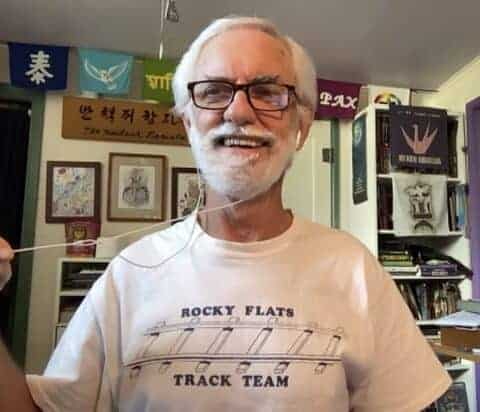 The Nuclear Resister has produced the following series of Nuclear Resister Stories for Nuclear Hotseat, a weekly podcast produced by Libbe HaLevy. In these 5-minute episodes, Jack Cohen-Joppa tells stories of actions for a nuclear-free future, culled from the archives of the Nuclear Resister newsletter.
-
Nuclear Hotseat #1: The First Nuclear Resisters
The first nuclear resisters.
Length: 4:20
-
Nuclear Hotseat #2: Sam Lovejoy
Fifty years ago, in a classic case of civil disobedience, a young anti-nuclear activist toppled a tower and blazed a trail through the courtroom that nuclear resisters have followed ever since.
Length: 4:44
-
Nuclear Hotseat #3: Greenham Common Women’s Peace Camp
In a legendary anti-nuclear victory, British women came together at the Greenham Common Women’s Peace Camp, and succeeded in kicking U.S. nuclear missiles out of England.
Length: 5:36
-
Nuclear Hotseat #4: The Plowshares Eight
In 1980, the Plowshares Eight hammered on nuclear warhead nosecones and sparked a global movement of direct action for nuclear disarmament.
Length: 4:48
-
Nuclear Hotseat #5: Bump the Dump
Thirty-five years ago, rural communities in western New York took nonviolent direct action to Bump the Dump, stopping the state and the nuclear industry from trashing their countryside with “low-level” nuclear waste.
Length: 5:00
-
Nuclear Hotseat #6: The Missouri Peace Planters
Missouri is the “Show Me!” state, and the Missouri Peace Planters did just that when they repeatedly occupied multiple nuclear missile silos in the summer of 1988, causing a furor that helped raise awareness of this hidden danger at the height of the Cold War.
Length: 5:02
-
Nuclear Hotseat #7: The Nuclear Train Campaign
There’s something about a train… and in the early 1980s, anti-nuclear activists from coast-to-coast turned that truth into a successful campaign that literally drove the bombs off the rails.
Length: 5:01
-
Nuclear Hotseat #8: Rocky Flats
In 1978, a late spring blizzard swept out of the Rocky Mountains and left behind a peace camp that occupied and repeatedly blocked the railroad tracks serving the Rocky Flats nuclear weapons plant.
Length: 5:00
-
Nuclear Hotseat #9: Hiroshima-Nagasaki 40th Anniversary
Eighty years after the atomic bombings of Hiroshima and Nagasaki, here’s a look back to the 40th anniversary in 1985, and some of the creative, widespread nonviolent action that galvanized the movement for a nuclear free future at the height of the Cold War.
Length: 5:02
-
Nuclear Hotseat #10: Nevada Test Site Backcountry
Before the U.S. stopped underground nuclear testing in 1992, activists were hiking into ground zero at the Nevada Test Site, forcing expensive delays and arrests while magnifying public support for the Comprehensive Nuclear Test Ban Treaty.
Length: 4:53
-
Nuclear Hotseat #11: Project ELF
A big ELF that menaced the North Woods and threatened the world for thirty years was finally chased out by the teach-ins, petitions, lawsuits and hand saws of popular resistance.
Length: 4:45
-
Nuclear Hotseat #12: Mordechai Vanunu
As a technician, Mordechai Vanunu was told “Do this, do that, don’t look left or right, don’t look at the whole machine.” But he did. And when he told the world what he saw, he took on the full weight of a nuclear state.
Length: 5:44
-
Nuclear Hotseat #13: Action Handbooks
A story from two generations ago about how tens of thousands of people from coast to coast organized to resist the “Atom State” by putting their liberty on the line.
Length: 5:40
-
Nuclear Hotseat #14: The Colrain War Tax Resisters
The longest war tax protest in U.S. history began with one couple’s conscientious refusal to pay for nuclear weapons or war, a commitment that inspired supporters nationwide and built community through the power of nonviolent direct action.
Length: 5:19
-
Nuclear Hotseat #15: Persistent Resistance
When Idaho seemed powerless to stop the feds from shipping nuclear waste into the state, one man didn’t give up, and found power in persistent resistance.
Length: 5:22
-
Nuclear Hotseat #16: Speaking Truth to Power
In the wake of the first U.S. war on Iraq, a quartet of nuclear abolitionists faced hostility from a federal judge and prosecutors in North Carolina as they spoke truth to power.
Length: 6:20
-
Nuclear Hotseat #17: Nuclear Free Hawai’i
In 1981, the Hawaii County Council declared the Big Island to be a nuclear free zone. Nonviolent direct action by a trio of aquatic activists revealed that the politicians didn’t really mean it.
Length: 6:10